 Öz Sağlık İşçileri Sendikası
İstiklal Marşı / Independence March
“İstiklal Marşı” (Independence March) is the national anthem of both the Republic of Turkey and the Turkish Republic of Northern Cyprus. It was officially adopted by the Grand National Assembly on 12 March 1921—two-and-a-half years before the 29 October 1923 establishment of the nation—both as a motivational musical saga for the troops fighting in the Turkish War of Independence (Kurtuluş Savaşı), and as an aspirational anthem for a Republic that was yet to be established.
Penned by Mr. Mehmet Âkif Ersoy, and ultimately composed by Mr. Osman Zeki Üngör, the theme is one of affection for the Turkish homeland, freedom, and faith, as well as praise for the virtues of hope, devotion, and sacrifice in the pursuit of liberty, all explored through visual, tactile, and kinesthetic imagery as these concepts relate to the flag, the human spirit, and the soil of the homeland. The original manuscript by Ersoy carries the dedication Kahraman Ordumuza – “To our Heroic Army”, in reference to the national forces that ultimately won the Turkish War of Independence, with lyrics that reflect on the sacrifices of the soldiers during the war.
The present-day anthem is a collective effort by several prominent poets, musicians, and composers that took form over several years due to the relatively tumultuous nature of the period in which it was crafted.
Even before the full official dissolution of the Ottoman Empire, a nationwide competition was organized in 1921 by the Turkish National Movement — an independent and self-organized militia force led by Mustafa Kemal Atatürk waging a lengthy campaign for independence against both invading foreign powers, due to the latter being treasonous and complicit in the partitioning of the Turkish homeland in the aftermath of the 1920 Treaty of Sèvres. The goal of the competition was to select an original composition suitable for a National March, intended to both motivate the militia forces fighting for independence across the country, and to provide inspiration and pride for a new homeland that would be established once victory was achieved.
A total of 724 poems were submitted. Mehmet Akif Ersoy, a well-known poet of the period, initially refused to participate due to a monetary prize being offered in the competition, but was subsequently contacted and convinced by the National Parliament to submit a poem and disregard the reward. The resulting ten-stanza-long poem written by Ersoy was recited to the National Assembly by representative Hamdullah Suphi, on 1 March 1921, where it was unanimously adopted by the deputies following evaluation by a parliamentary committee. The prize of the competition was later bestowed on a society of veterans.
Shortly thereafter, twenty-four composers participated in another competition arranged for the selection of a musical composition that would best suit the elected anthem. The committee, which was only able to convene in 1924 due to the 1919–1923 Turkish War of Independence, adopted the music composed by Ali Rıfat Çağatay.
This early composition by Çağatay lasted only six years. In 1930, a new composition by Osman Zeki Üngör, virtuoso composer and the first conductor of the Presidential Symphony Orchestra of the Republic of Turkey, was adopted as a permanent musical arrangement by Parliament. Shortly thereafter, in 1932, Ottoman Armenian musician Edgar Manas was commissioned by the Turkish government to harmonize and orchestrate the melody created by Üngör, and the final and official version of the anthem took form.
For more details please visit the Wikipedia, the free encyclopedia.
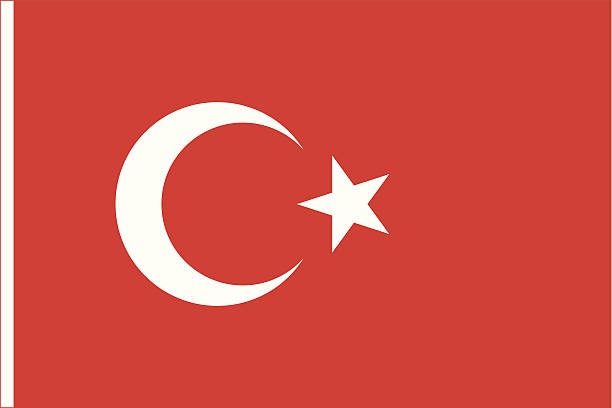
Turkish lyrics of Türkiye’s national anthem
Korkma! Sönmez bu şafaklarda yüzen al sancak,
Sönmeden yurdumun üstünde tüten en son ocak.
O benim milletimin yıldızıdır, parlayacak;
O benimdir, o benim milletimindir ancak.
Çatma, kurban olayım, çehreni ey nazlı hilal!
Kahraman ırkıma bir gül; ne bu şiddet, bu celal?
Sana olmaz dökülen kanlarımız sonra helal.
Hakkıdır, Hakk’a tapan milletimin istiklal!
Independence March / English Version
Fear not; For the crimson banner that proudly ripples in this glorious dawn, shall not fade,
Before the last fiery hearth that is ablaze within my homeland is extinguished.
For that is the star of my people, and it will fore
It is mine; and solely belongs to my valiant nation.
Frown not, I beseech you, o thou coy crescent!2
Smile upon my heroic nation! Why the anger, why the rage?
Our blood which we shed for you shall not be worthy otherwise;
For freedom is the absolute right of my God-worshipping nation!
Please visit this web site for more details.